
Bitcoin Mining Difficulty
Historical mining difficulty. Shows green if the difficulty went up and red if it went down, compared to previous epoch.
Data & charts updated every hour
Hashrate is the total computing power that miners are dedicating to the Bitcoin network, measured in hashes per second (H/s). Because the number is enormous, it's usually shown with a metric prefix: kilo (kH/s), mega (MH/s), giga (GH/s), tera (TH/s), peta (PH/s), and exa (EH/s). One EH/s equals a quintillion (1,000,000,000,000,000,000) hashes every second. As of today the network runs at roughly —. A higher hashrate means more machines are securing the chain, which makes the network harder to attack.
This chart overlays two series on a shared timeline so you can compare them:
- Hashrate (orange) — total mining power, on the right axis in EH/s.
- Price (green) — the Bitcoin price, on the left axis in USD. It's hidden by default; click Price in the legend to show it.
Use the controls above the chart to switch line / area / bar style, change the moving-average smoothing (SMA), toggle a linear or log scale, jump to a time range (1M–All), and turn on halving markers. Hover any point to read the exact hashrate and date. Because early hashrate values are tiny next to today's, switch to Log to make the 2010–2018 period readable.
This chart overlays two very simple charts
- The Bitcoin Price Chart
- The Mining Hashrate Chart
The idea behind this chart is to illustrate any correlation between the price of bitcoin (shown in green) and the hashrate (shown in orange). Proponents of this chart assert that traders might be able to determine the direction prices will go based on how much hashing power is being lost or added to the network. If hashrate goes down, this might indicate bearishness on the part of miners or weakness in the market causing downward pressure on the price.
The most obvious criticism is that generally, there is almost no correlation between price and hashing power. In fact, when one looks at the chart, one notices that while the price of bitcoin is all over the place, hashing power is steady line that goes almost constantly upward. The other criticism is that proponents get this relationship backwards. Miners live and die by the profitability of their operation which is a function of their cost of electricity and the price of bitcoin. If you ask almost any miner, they will tell you that it is not hashrate that affects the price of bitcoin. Rather, it is the price of Bitcoin that affects the hashrate. When the bitcoin price is high, more hashrate joins the network as less efficient miners can remain profitable due to fatter margins. As the price goes down, the margin thins and fewer miners can remain profitable. Despite this fact and any local, short term correlations, we still see hashrate tending to increase over the long term and that is because most ASICs eventually find themselves in the hands of more efficient miners who buy up the hardware once owned by their less efficient competitors. In other words, no hardware remains idle as long as there is someone who can mine with it for a profit.
Convert between hashrate units (H/s, kH/s, MH/s, GH/s, TH/s, PH/s, EH/s). Type in any field and the rest update instantly.
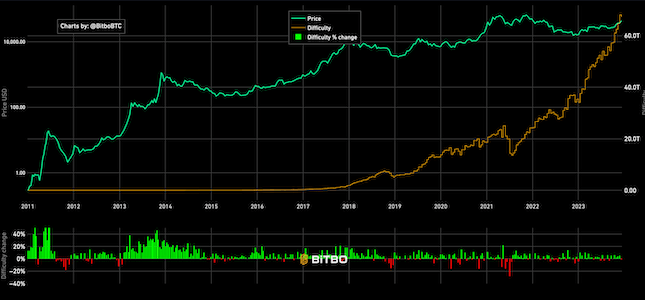
Historical mining difficulty. Shows green if the difficulty went up and red if it went down, compared to previous epoch.
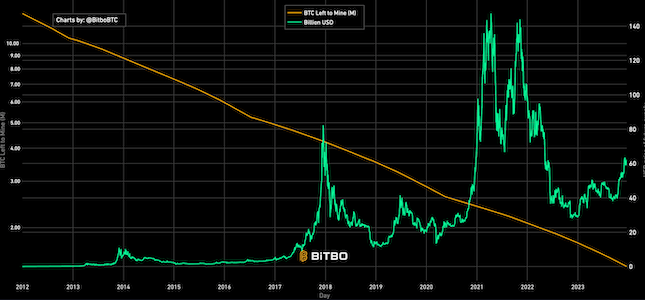
Shows the USD value of the future outstanding Bitcoin supply that has not been mined.
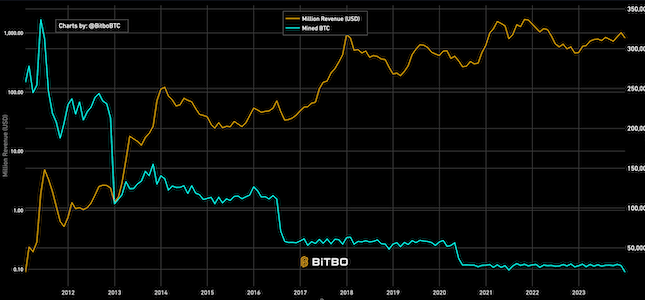
Shows the amount of revenue earned monthly by miners in USD and BTC.
Bitbo's charts section offers a wide range of Bitcoin charts and metrics.
If you have any questions, comments, or feedback please reach out to us via Twitter or via email at info@bitbo.io.