
Bitcoin Fear and Greed Index
A sentiment analysis tool for Bitcoin and crypto markets, indicating when markets are overly fearful or greedy.
| Asset | Current | 1D | 7D | 1M | 6M | 1Y | ATH | ATL |
|---|---|---|---|---|---|---|---|---|
|
|
57.52% | -0.04% | +0.19% | -0.51% | -0.71% | -3.65% |
92.86%
Dec 21, 2015 |
36.25%
Sep 09, 2022 |
|
|
9.86% | +0.03% | +0.18% | +0.76% | -2.31% | +0.60% |
32.64%
Jun 19, 2017 |
0.90%
Oct 19, 2015 |
|
|
14.32% | +0.01% | +0.19% | +0.23% | +5.78% | +8.25% |
15.30%
Jun 30, 2026 |
0.01%
Nov 09, 2015 |
BTC dominance excluding stablecoins — Bitcoin's share of the crypto market after removing stablecoin market cap.
Monthly change in BTC dominance (percentage points). Green = dominance gained, Red = dominance lost.
Rolling 30-day and 365-day change in BTC dominance (percentage points).
BTC dominance with 50-day and 200-day moving averages.
BTC dominance high and low for each year, with dates.
| Year | High | High Date | Low | Low Date | Range |
|---|
Look up BTC dominance for any historical date.
Bitcoin dominance measures Bitcoin's share of the total cryptocurrency market capitalization. If Bitcoin's market cap is $1 trillion and the entire crypto market is $2 trillion, Bitcoin dominance is 50%. It's one of the most widely tracked metrics for understanding capital flows across the crypto ecosystem.
Rising BTC dominance means capital is flowing into Bitcoin faster than into altcoins. This often happens during bear markets when investors move to the relative safety of Bitcoin, or during early bull markets when Bitcoin leads the rally before altcoins catch up. It can also signal decreasing confidence in altcoin projects.
BTC dominance falls when altcoins are gaining value faster than Bitcoin. This typically occurs during "alt seasons" — periods of speculative enthusiasm where capital rotates into smaller-cap tokens. The growth of stablecoins and DeFi protocols has also structurally reduced Bitcoin's dominance over time by adding market cap to the overall crypto ecosystem that isn't Bitcoin.
BTC dominance is calculated by dividing Bitcoin's market capitalization by the total cryptocurrency market capitalization, then multiplying by 100 to get a percentage. For example: (Bitcoin Market Cap / Total Crypto Market Cap) × 100. Different providers may include or exclude certain tokens (like stablecoins), which is why dominance figures can vary across sites.
Many traders use BTC dominance as a macro indicator for portfolio allocation. Rising dominance often suggests it's better to hold Bitcoin over altcoins, while falling dominance may signal an alt season where altcoins outperform. However, it should be used alongside other metrics — dominance alone doesn't indicate whether prices are going up or down in absolute terms.
Bitcoin dominance was nearly 100% in the earliest days of cryptocurrency when Bitcoin was essentially the only coin. It reached its lowest point of around 32% in January 2018 during the ICO boom when thousands of new tokens launched. Since then, dominance has fluctuated between roughly 40% and 70%, depending on market conditions and the growth of competing ecosystems.
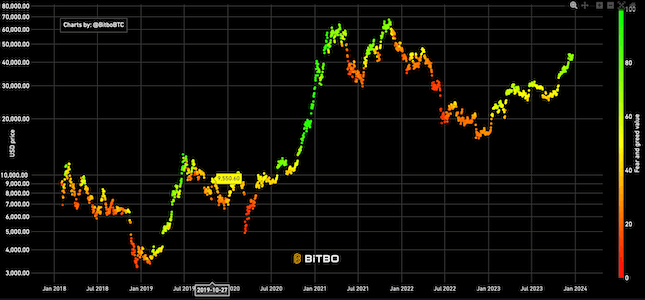
A sentiment analysis tool for Bitcoin and crypto markets, indicating when markets are overly fearful or greedy.
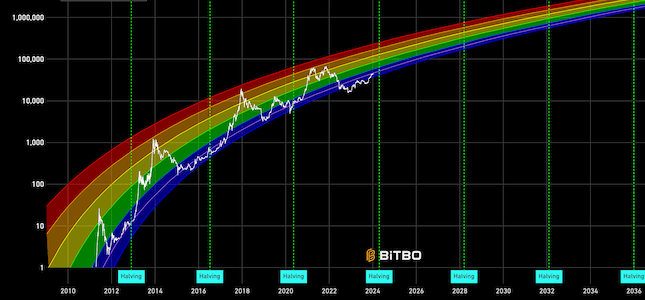
A Bitcoin rainbow chart using only the halving dates as data.
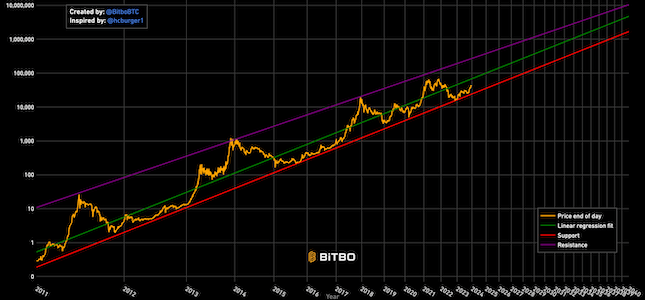
Bitcoin's natural long-term power-law corridor of growth.