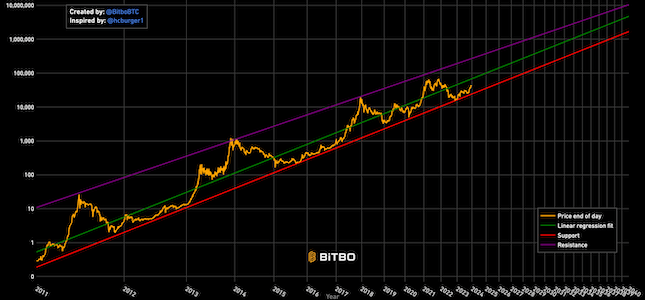
Long Term Power Law
Bitcoin's natural long-term power-law corridor of growth.
Data & charts updated every hour
Enter an annual growth rate to project future Bitcoin prices based on today's price.
Enter an amount to invest today and see what it could be worth in future years according to each price model.
Price predictions from prominent Bitcoin analysts, hedge funds, and institutions. Click any prediction below for details.
| Source | 2030 | 2040 | 2050 |
|---|---|---|---|
| Michael Saylor | — | — | $13M |
| Hal Finney | — | — | $10M |
| Jack Dorsey | $1M+ | — | — |
| Arthur Hayes | $750K (2027) | — | — |
| Cathie Wood (Ark Invest) | $300K–1.5M | — | — |
| Robert Kiyosaki | $1M | — | — |
| VanEck | — | — | $2.9M |
Click on a prediction to read more.
MicroStrategy CEO Michael Saylor predicts Bitcoin could reach $13 million in the next 21 years, a timeframe that aligns with Bitcoin's fixed supply of 21 million coins.
"If you look at the way that he extrapolated these numbers... it does make some sense. I think he put it at 7% of global capital and gets us to three, four million, and then 13 million is a simple 3X from there over a cycle."
The prediction is based on Bitcoin's four-year price cycles, inflation patterns, and the potential for Bitcoin to capture a larger portion of global capital.
Source →Hal Finney, one of Bitcoin's pioneers who worked alongside Satoshi Nakamoto, made this bold prediction just one week after Bitcoin's launch. His vision was based on Bitcoin potentially becoming the dominant global payment system.
As an amusing thought experiment, imagine that Bitcoin is successful and becomes the dominant payment system in use throughout the world. Then the total value of the currency should be equal to the total value of all the wealth in the world. Current estimates of total worldwide household wealth that I have found range from $100 trillion to $300 trillion. With 20 million coins, that gives each coin a value of about $10 million.
While no specific timeframe was given, Finney was among the first to envision Bitcoin's potential as both a store of wealth and a decentralized payment system, demonstrating remarkable foresight in the cryptocurrency's earliest days.
So the possibility of generating coins today with a few cents of compute time may be quite a good bet, with a payoff of something like 100 million to 1! Even if the odds of Bitcoin succeeding to this degree are slim, are they really 100 million to one against? Something to think about...Source →
Jack Dorsey, Twitter founder and Block CEO, predicts Bitcoin will exceed $20 trillion market cap by 2030.
"At least a $1 million. I do think it hits that number and goes beyond. The most amazing thing about bitcoin, apart from the founding story, is anyone who works on it, or gets paid in it, or buys it for themselves—everyone who puts any effort in to make it better—is making the entire ecosystem better, which makes the price go up."
His prediction is backed by Block's significant investment in Bitcoin infrastructure, including their commitment to invest 10% of gross profit from Bitcoin products into BTC monthly, development of a hardware wallet, and plans for a full Bitcoin mining system.
"The internet will have a native currency; it's just a matter of time. This won't happen overnight. The existing and emerging financial systems will operate in parallel for some time."Source →
The BitMEX co-founder projects $250,000 Bitcoin in 2026 and $750,000 in 2027. His thesis is built entirely around liquidity — he argues the Trump administration will flood the system with money to stabilize growth, which is rocket fuel for scarce assets like Bitcoin.
"Governments spend. Currencies weaken. Scarce assets go vertical."
Hayes also ties his forecast to geopolitics, arguing that prolonged U.S.-Iran conflict gives the Federal Reserve cover to ease monetary policy. History shows that during major wars, liquidity tends to expand, not contract.
Source (March 2026) →In ARK's Big Ideas 2025 report, Cathie Wood's team updated their Bitcoin price targets for 2030, projecting bear, base, and bull cases of ~$300,000, ~$710,000, and ~$1.5 million per bitcoin, respectively.
The model is based on Bitcoin's penetration into institutional investment (~$200T TAM), its role as "digital gold" competing with gold's ~$18T market cap, emerging market safe haven demand, nation-state and corporate treasury adoption, and Bitcoin on-chain financial services.
"Digital gold contributes the most to our bear and base cases, while institutional investment contributes the most to our bull case."
ARK also ran an experimental model based on Bitcoin's "active supply" (accounting for lost/vaulted coins), which produced targets roughly 40% higher than the base model.
Source →Robert Kiyosaki, bestselling author of "Rich Dad Poor Dad," predicts Bitcoin could reach $1 million per coin by 2030. He has been buying BTC since $6,000 and focuses on accumulation over price.
"Poor people focus on price. Rich people on quantity. While I watch the price of Bitcoin I focus on how many Bitcoin I own."
His bullish stance stems from a pessimistic economic outlook — he warns of the "biggest crash in history" and sees Bitcoin, along with gold and silver, as hedges against what he calls "fake money" and potential hyperinflation.
Source →VanEck's long-term capital market assumptions project Bitcoin reaching $2.9 million by 2050 in their base case (15% CAGR), with a bear case of $130,000 (2% CAGR) and a bull case of $53.4 million (29% CAGR).
The model is based on Bitcoin settling 5-10% of global international trade, 5% of domestic trade, and becoming a reserve asset for central banks. VanEck suggests a 1-3% strategic portfolio allocation, noting that allocations up to 20% have historically optimized Sharpe ratios.
"As developed markets face a sovereign debt super-cycle, the risk of zero exposure to the most established non-sovereign reserve asset may now exceed the volatility risk of the position itself."Source →
Side-by-side comparison of all four price models used on this chart. Values are the model's projected price for each date.
| Date | Power Law | Stock to Flow | Stock to Income | Rainbow HPR | Model Average |
|---|
Estimated dates when the average of all four models reaches key price milestones. Milestones already reached show the actual date.
| Price Target | Estimated Date (Model Avg) | Status |
|---|
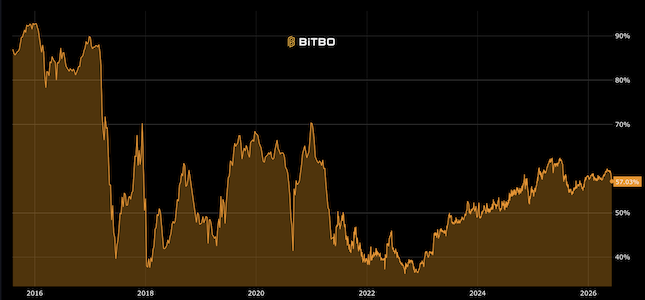
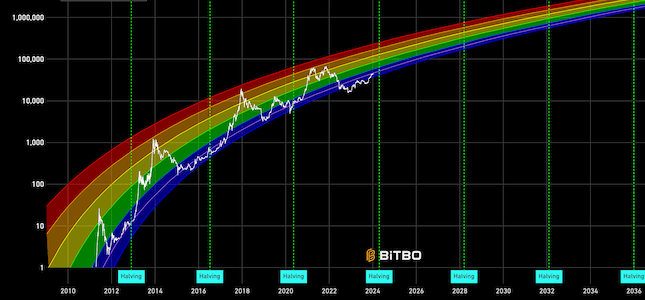
This chart shows the Bitcoin price, and four different price models that attempt to project Bitcoin's price:
- Stock to flow
- Stock to income
- Power Law
- HPR Rainbow
The Bitcoin power law was created by Giovanni Santostasi
(@Giovann35084111 on Twitter) in 2015.
Giovanno is a physicist, neuroscientist, and financial analyst.
You can read his recent overview of how he created the model
here.
The power law aims to project the price of Bitcoin based on the following assumption:
Bitcoin's price, users, and mining power increase in a predictable way, like a city growing, where each part influences the others in a continuous feedback loop.
Stock to flow was created by PlanB in 2019.
Stock to flow is a model used to determine the scarcity of assets. The model can also be used to predict prices of assets based on scarcity.
Formula:
The formula for stock to flow is simple.
Stock to flow equals: Stock / Flow
Stock is the current amount of an asset.
Flow is the amount of an asset produced in a given year.
Let's say there are 20 million bitcoins, and 200,000 new bitcoins are issued each year.
Our equation would be:
20,000,000 total BTC / 200,000 new BTC per year = 100 stock to flow (S2F)
Based on this S2F value, a model is created to attempt to project the Bitcoin price based on scarcity.
The Bitcoin Stock to Income model is based on the Stock to Flow model, with two major differences:
- Stock to flow does NOT account for transaction fees earned by miners, only new bitcoins. Stock to income includes miner fees in flow.
- Stock to flow only used data until March 2019, which is when it came out. Stock to income is re-generated daily, ensuring an accurate model.
Stock to income aims to paint a more accurate projection of the Bitcoin price, using current data and accounting for miners' transaction fees earned as flow.
Created by @_digitalik_.
The Halving Price Regression (HPR) is a non-linear regression curve calculated using only the Bitcoin prices on the Bitcoin halving dates.
This method excludes the hype cycles to create a conservative price estimate.