
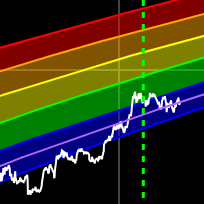
Bitcoin Price Predictions
Shows 4 Bitcoin price models: power law, stock to flow, stock to income, and HPR Rainbow.
Data & charts updated every hour
The Bitcoin network relies on a process called mining, which uses computational power (hashrate) to verify transactions and secure the network.
This process consumes energy, and we can estimate the energy used per transaction using the following formulas:
Daily Hashrate (TH/s): The total computational power of the Bitcoin network, measured in terahashes per second, averaged over a day.
Efficiency (J/TH): The energy efficiency of mining hardware, measured in joules per terahash.
Daily Energy (GW): The total energy consumed by the network per day, measured in gigawatts.
Daily Transactions: The total number of Bitcoin transactions processed in a day.
Transaction Energy (GW): The average energy consumed per transaction, measured in gigawatts.
Where:
Transaction Energy Estimate: The estimated average energy used per Bitcoin transaction is shown in green. This is based on the formulas above. We are using the 14 day moving average of transactions to smooth out the data.
High and Low Estimates: The possible range of transaction energy is displayed as a tunnel around the most realistic estimate, reflecting uncertainty in hardware efficiency and network conditions. This can be enabled via the legend.
Actual USD Price: The price of Bitcoin in USD is shown in orange, shown for comparison on a logarithmic scale. This can be enabled via the legend.
The chart allows you to see how the energy required for each transaction changes over time, and how it relates to Bitcoin’s price. Hover over the lines to see exact values for each date.
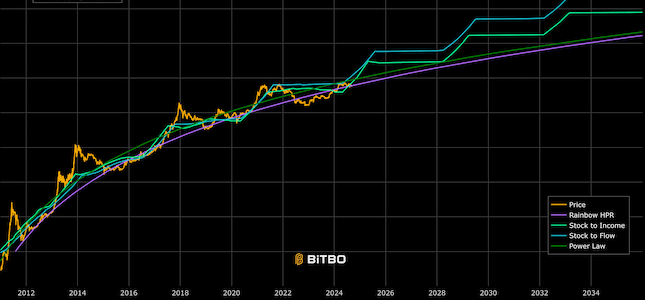
Shows 4 Bitcoin price models: power law, stock to flow, stock to income, and HPR Rainbow.
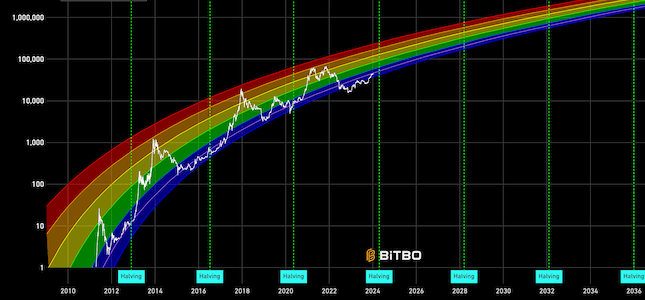
A Bitcoin rainbow chart using only the halving dates as data.
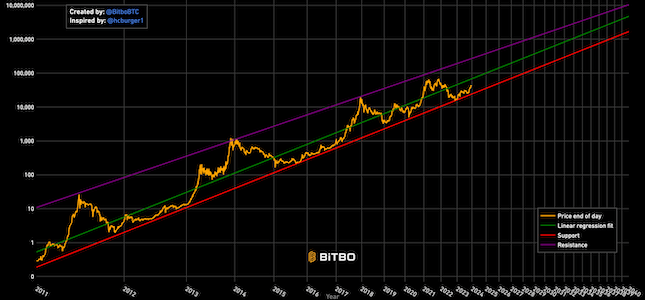
Bitcoin's natural long-term power-law corridor of growth.
Bitbo's charts section offers a wide range of Bitcoin charts and metrics.
If you have any questions, comments, or feedback please reach out to us via Twitter or via email at info@bitbo.io.